

rem
Trigger warning: suicide. If you don’t wish to read the story of a suicide, skip this chapter.
If you’re thinking of taking your life, please talk to someone about it. Whatever you’re going through, going through it alone is a choice and you can make a better choice. I did.
If you’re in crisis, talk to someone immediately. Call the national mental health hotline at 988.
80. Qesh (ii) @Lurah
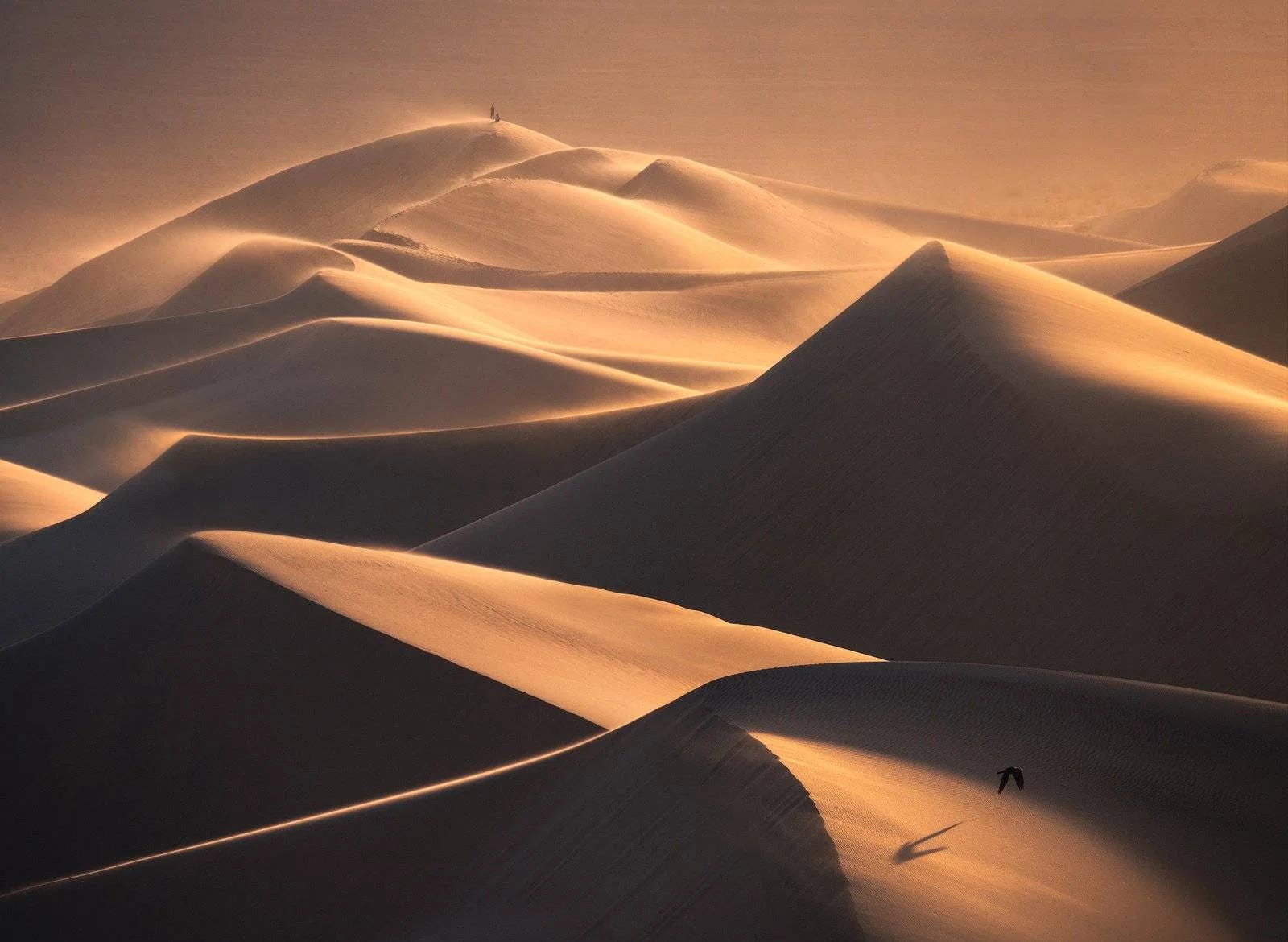
Except for rodents, lizards, snakes, and the occasional stunted cactus, nothing at all lived in Ayn-qesh. Mountains to the west cast a rain shadow over the land. Within it, life was scarce, short, brutal. It was plain why no one, neither Far nor Djer, lived here. It was not a land of the living.
Dune upon mountainous dune in every direction, the desert swallowed me. Day by day, having ceased altogether to eat, I grew weaker. Recalling the tale of the lost sah who in delirium ate sand, I did not deny myself water, but I drank as little as I could. In any case, Qeht-qahlif needed to drink. There was no reason for the camel to suffer.
My belly became an empty, yawning cave. I gave my hunger no heed. It seemed a trifle. I began to waste away.
Still Luht shadowed me, nearer now. Earlier in the journey, I stopped Qeht-qahlif from time to time and gazed back at my shadow. No longer. I knew he was nearer only because now and then I heard him yelling, loosing his rage. No threats reached my ears, only denunciations, insults. I ignored him. What he intended did not interest me.
Impossibly large – or perhaps its size was merely a trick of my mind – a buzzard alighted atop a dune and watched me pass below. Far-nah-qesh, I reckoned. If indeed it was the Far-nah, she did not transfigure herself. I did not care to see her womanly form, to hear any offers of mercy and help.
Hours later, as I noticed a sidewinder slithering down a dune, I saw the buzzard again. She perched on the dune, watching my progress. Then her wings beat the air and her talons tore the sand as if tearing at a carcass. And then the bird took flight, but not alone. The top of the dune went with her like a morsel of flesh or a ragged storm cloud. It overshadowed me, raining sand. Out of the wound in the earth poured thousands of vipers, rattlesnakes sliding over each other in a massive tangle. They spilled over the lip of their pit and sped down the dune towards me.
Faced with this avalanche of fast, venomous, rattling death, my heart knew terror and wanted to flee. I whipped Qeht-qahlif’s flanks. Rather than run, though, he came to an abrupt halt. I whipped again, cursed at him. He refused to move. I balled hands into fists around his reins, set my jaw, and stared at the swiftly approaching vipers.
Then come and claim me, I thought. As well this way as another.
The vipers vanished. All but one: the sidewinder crossed our path several yards ahead, went away on its own errand. Then Qeht-qahlif trotted on as before, nonchalant. I looked up at the dune: no hellish pit lay there. The dune was whole, only a hill of sand like all the others. I scanned the sky. The buzzard was nowhere in sight.
“Is Far-nah-qesh tricking me,” I said aloud, “or am I tricking myself?”
Qeht-qahlif grunted noncommittally.
That was only the first of my visions. The sun transformed from radiant fire to a pale moon, seeming to bless, not burn me. Black tar bubbled from the sand, spread into a viscous lake that solidified as a floor of glass. Qeht-qahlif trod the glass.
One night, the stars grew in size, becoming large, variously colored orbs. They flashed, fell, frothed to nothingness in the sky like meteors.
The next day, in late afternoon, people appeared on the horizon. The forms of three people wobbled in the heat haze. For no reason, I knew they were the uhn-qah of Qehlim and our children. They held each other’s hands. They seemed to be walking towards me. I rode on, but I never drew nearer to them.
Qeht-qahlif anchored me to sanity. Each time I saw a vision, I spoke to the camel. Whether or not he knew I needed to hear him, he answered me with a grunt.
As my third day in Ayn-qesh ended, I woke from a stupor in which I was riding to notice a long shadow across the sand ahead of us – the shadow of a camel and rider.
Now, Luht was riding in company with me. He saw me glancing at him and said, “You did not lie.” We passed the rest of the day in silence. That night, he camped with me and built a fire which we shared.
Luht had killed a rattlesnake, and he roasted its skinned, headless length over the fire. The meat’s aroma tantalized me, and my belly complained of its emptiness.
“Are you not eating?” Luht said.
“I want nothing,” I muttered.
He grimaced. “You should eat, but suit yourself.”
The next morning, against longstanding habit, I woke late. The day was already hot, and I lay bathed in sweat. Over me was the shadow of a foreboding, fearful dream, but I had forgotten what it was. I rolled over. The fire was cold, only ashes. Luht sat his camel nearby, ready to travel, peering down at me.
“You had nightmares,” he remarked as I got up. “Thrice you woke me with your cries. I am amazed you did not wake yourself.”
Without a word, I rolled up my bed, packed it, saddled Qeht-qahlif. As we rode on, Luht said, “If you wake me tonight, woman, I will kill you with your own sword in your sleep.”
“Do you swear to it?” I said. “Then I hope to dream again.”
He only scoffed.
The terrain was changing. For days, I had ridden among high dunes, but now the land began to open out and flatten. Mesas rose in the distance. By noon, we were riding into a country of windswept sandstone. Far-nah-sol remained merciless. I felt like hot steel under the blacksmith’s hammer. In the sun’s glare, what had been just a headache grew into a piercing pain behind my eyes.
The uhn-qah of my lost family reappeared, but now there were four people in the heat haze – my sister-qeht Rasalah had joined my husband and children. Hand in hand, the specters beckoned to me. Every moment seemed laced with the promise they would speak to me, if only I could lay aside some burden and listen. They vanished, appeared, vanished again. A voice came to me as if from very far away: “Lurah!”
Then I knew the voice – Luht’s – and woke from yet another stupor. No specters led me. I looked at the vengeful sah and croaked, “What?”
“How far are you going?” he said hotly.
“Do you wish to turn back, sah?”
He scoffed again.
“Kill me,” I suggested.
“Without a fight? No. You will take back your sword and face me in im-hel-qah.”
I halted Qeht-qahlif, took a long gulp from my waterskin, and reconsidered his proposition. I was weaker than I had ever been, now certainly no match for Luht.
“All right, im-hel-qah,” I agreed.
“What? Why now? Why here?”
“How far, you ask. You are right. This only ends one way. With a death. If that is so, I might as well get it over with.”
We barracked our camels, dismounted, faced. Luht unchained Ilay’s sword from his belt and formally presented it to me in its sheath. We stepped apart, drew swords.
At first I took a tail stance, but seeing Luht was not lured in, I brought my sword forward and raised it. I moved slowly, and the sword wobbled. I tried to focus my eyes on Luht: he was growing blurry, dark, like a specter himself. He approached me, lifted his sword, and swung. I was again slow to move, reacting late, and his sword was just a few inches from my face when I managed to parry it away. Now darkness was creeping in on my vision from all sides, turning day to night.
“Halim bitch!” Luht barked. “That is no way to fight. Do not insult my hel.”
“This is as well as I can fight.”
A silence. “Are you that weak, Uhn-say-lurah? When did you last eat?”
“You wanted to fight,” I said, my own voice sounding distant, removed, no part of myself, as I stumbled towards Luht’s voice. “Now we fight.”
“We are not equals!”
Out of breath and on the verge of collapsing, I halted, lowered my sword, closed my eyes. This craven will not do it, I thought. He will follow me to the very ends of Ayn-qesh, but he will not keep his word.
As I dropped the sword and sank to my haunches, I knew the burden I carried – a desire, in spite of everything my life had become, to live still – and finally let it go. The darkness was yet all around me when I opened my eyes, but I heard the voice of a child, a girl – it was Rasalah. Do not be afraid, she said. Come. We are waiting.
I felt numb all over. With my last strength, I drew my dagger, pressed its edge to my wrist, and slashed. Then I fell, spent. “Lurah!” Luht yelped, and I felt him clutching me, but then I felt and knew no more.
< Previous chapter | Index | Glossary | Appendix | Next chapter >
rem
Many thanks to filmmaker and photographer Michael Shainblum for use of the image accompanying this chapter. Click here to see more of Michael’s stunning work.
rem
One is welcome to comment.
